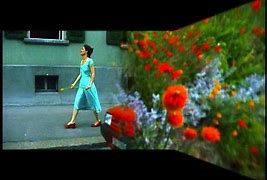
I chose the Pipliotti Rist’s – Ever is Over All. It shows a youthful woman cheerfully walking down a European residential-neighborhood sidewalk, in broad daylight gleefully smashing the passenger-side windows of the cars parked curbside. As she is illegally destroying private property, a female police officer is seen behind the woman as she is actively committing this offense. However, instead of arresting her, the policewoman salutes her with a smile and walks on. A young boy is seen riding his bicycle in the opposite direction as the woman passes by him. Likewise, with the adult male, who turns to watch, astonished and confused, this young woman committing these unladylike acts. Accompanying the central video is an adjacent one, playing simultaneously with a looped-reel of red flowers, in an open, sunny, warm field, blowing in the gentle wind.
I believe the central theme is women’s liberation. Essentially, women embracing their independence by overcoming the stereotypical collective, domestic positions attributed to them, especially in Europe. It is clearly communicated by the fact that the woman is alone, not with a man, baby, or child when, normally, she would be at home attending to her husband and children while cooking and cleaning during the daytime hours instead of being outdoors. Moreover, it is also demonstrated by her brazen acts of public destruction to the family car as a form of revolt against the cultural and societal restraints.
The decision to specifically target the passenger-side windows on the parked cars, I presume, signals the rejection of the subservient woman, who is not in command. Women commonly were passengers, not drivers of their lives, homes, choices, careers, etc. Rist also expresses the change has already begun by featuring the female police officer who instead of condemning the woman, commends her and her decision to literally shatter that glass ceiling, or in this case, the glass windows, with a salute, nod, and a smile.
This piece challenges how television is viewed because the majority of the genres available to us on the aforementioned medium are strictly amusement based, which is basically the absence of reflection or thought. Hence, the term amusement.
Whereas in Rist’s Ever is Over All, the symbolism is tremendously rich and provocative that it becomes even more complex with multiple views because there is a lot to observe and unpack. Therefore, it is musing.
 Insights