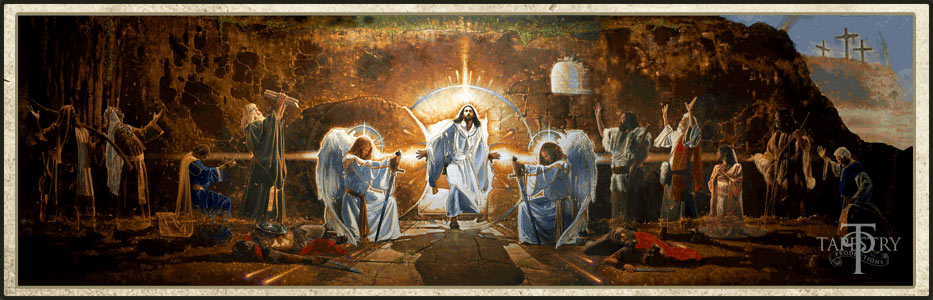
Jesus Christ’s resurrection is the single most miraculous, prophetic act in history which distinguishes Christianity from all other religions, theologies, and philosophies. DiCianni’s interpretation of the historical event is captured, befittingly, on a twelve-foot high by a forty-foot wide mural to honorably signify the monumental importance of this remarkable moment while the jubilancy of the setting welcomes full participation to all that behold it.
As Jesus emerges victoriously from the Tomb, He becomes the central theme to the painting. He is then greeted on His right and left by prophets, royalty, and other important biblical figures. Moses and Elijah are on the outer most sides of Jesus, behind the Angels. Behind Moses is King David, kneeling, acknowledging Jesus as the King of Kings. Then behind David is the prophet Isaiah, who proclaimed Jesus as the Prince of Peace. Behind Isaiah is Abraham, the father of the nations. On Jesus’ left, after Elijah, is Noah, Queen Esther, John the Baptist, and Daniel, who was the governor of Babylon. All of those present proclaimed or prophesized Jesus’ birth, death, resurrection or divinity except for the Roman soldiers.
The subtle elements in the painting, such as the rock beginning to crack under the cross at Calvary due to the earthquake, the dove, symbolizing the Holy Spirit, flying out of the tomb, and the transparent figures indicating another dimension are, I find, the most intriguing.
DiCianni’s The Resurrection resonates with me because it beautifully, gloriously portrays Jesus rising from the dead, thereby fulfilling prophecy as He reconciles us to Himself through His sacrifice for all who believe. It is profound and the emotion it evokes communicates a deep connection which can speak to my faith. Jesus’ resurrection is the central theme of DiCianni’s powerfully illustrated painting decisively embodying its divine declaration: Jesus is God.
 Insights